


Table of Contents
Some of you may not believe this … or may not want to hear it
YES – they CAN be wrong, in fact I assume they are all wrong these days, because there is no way to guarantee they are RIGHT.
So I like to ask, WHY do you want to prove something is AI-created?
Do you want to shame a person, business, competitor or website?
If so, perhaps there are other avenues to go down to discredit them if that’s really what you want to do.
AI – artificial intelligence – is a new arena, it’s the Wild Wild West and we, as average users, have no control over it.
I did tests using my own text and my own paintings and drawings
If you’re wondering why I’m wondering about these AI Detectors, it’s because I uploaded several of my own photos of my hand-painted designs, and they were each flagged as “AI” – when I am the artist, I did the paintings, and took the photos and uploaded them to the sites which state they can tell if something’s AI-generated or not.
- So my results – 100% wrong.
I tried similar tests with TEXT, books, articles etc which I’ve written myself (I’ve been a prolific writer for my whole life).
- Hmmmm bad news – each text item I uploaded to different sites flagged each one as partially “AI created”.
- This is of course 100% incorrect, and proved again to me that there is no 100% guaranteed way to prove one way or the other when using these online “AI Detector” services.
Results of ONE of my own images uploaded
I created this image below, I came up with and designed the “person” and added one of my own book covers, and this is the result:
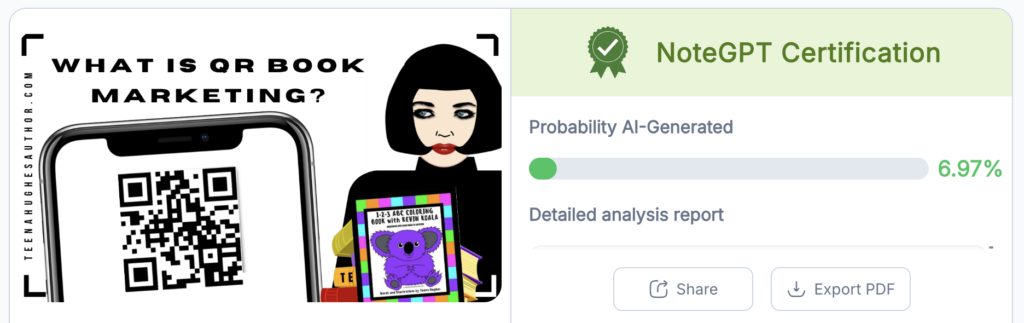
- AI DETECTED? Yes, 6.97%
This is to show you that it’s pretty impossible for an AI DETECTOR to ascertain what’s been created by a human :-(
The point I’d like to share with you is that:
- we cannot accept that AI Detectors “know” the truth, the reality
- we should take all results with a grain of salt (remember that wonderful old saying?)
- we should be cautious and not jump to any conclusion.
Daily I see people writing/commenting on Facebook and saying with indignation, “That’s AI!!” – when in fact no-one can deduct that, especially not websites :-)
A quick search on Google shows the following detail:
Types of Errors
- False positives: Flagging 10% to over 27% of genuine human-written academic or professional work as AI-generated.
- False negatives: Missing 15% to 30% of actual AI-generated text, particularly if the content has been lightly paraphrased or edited.
- Bias errors: Disproportionately misclassifying essays written by non-native (ESL) English speakers or neurodivergent writers because their natural syntax deviates from standard training datasets.
Have you been wondering:
Why Detectors Fail
- Predictable human patterns: Structured, formal, or uniform human writing closely mirrors the statistical patterns algorithms associate with machines.
National Institutes of Health (NIH) | (.gov)
- Easy evasion: Simple prompt tweaks, minor typos, or light manual rewrites can trick detectors into missing AI text or misidentifying human text.
EdScoop +1
- Lack of context: Detectors rely on probability scores rather than proof, meaning they guess based on word patterns instead of knowing how a document was created.
Articles cited in the Google search above:
- National Institutes of Health https://pmc.ncbi.nlm.nih.gov/articles/PMC12331776/
- Edscoop – https://edscoop.com/ai-detectors-are-easily-fooled-researchers-find/
- Winston AI https://gowinston.ai/how-often-are-ai-detectors-wrong/
How to prove you didn’t use AI?
Proving you did not use AI requires showing your working process: version history, draft notes, and research trails. Because AI detectors only measure statistical probability and frequently produce false positives, you cannot definitively prove a negative with a score alone. Instead, you must rely on concrete metadata and personal context – https://libguides.hiu.edu/c.php?g=168882&p=10227562
What to do next?
Perhaps this Guide on how to manage false accusations and present your edit history effectively can help:
How to Handle an AI Detector False Positive (And Prove You Didn’t Cheat)
Did this information help on Can AI DETECTORS be WRONG?
I hope this short overvied has been helpful – please do let me know – I’m happy to clarify and provide more info if you need it :-)
Here are a few ways to get in touch with me:
- on my website
- on YouTube
- on Facebook
- if you’re in Australia, feel free to call or text me on 0408-801-808
- if you’re calling from outside Australia, feel free to call or text me DURING THE RIGHT TIME ZONE TIME on +61-408-801-808 (for example US and Canada, dial 011-61-408-801-808)
Ciao ciao for now,
Teena Hughes
